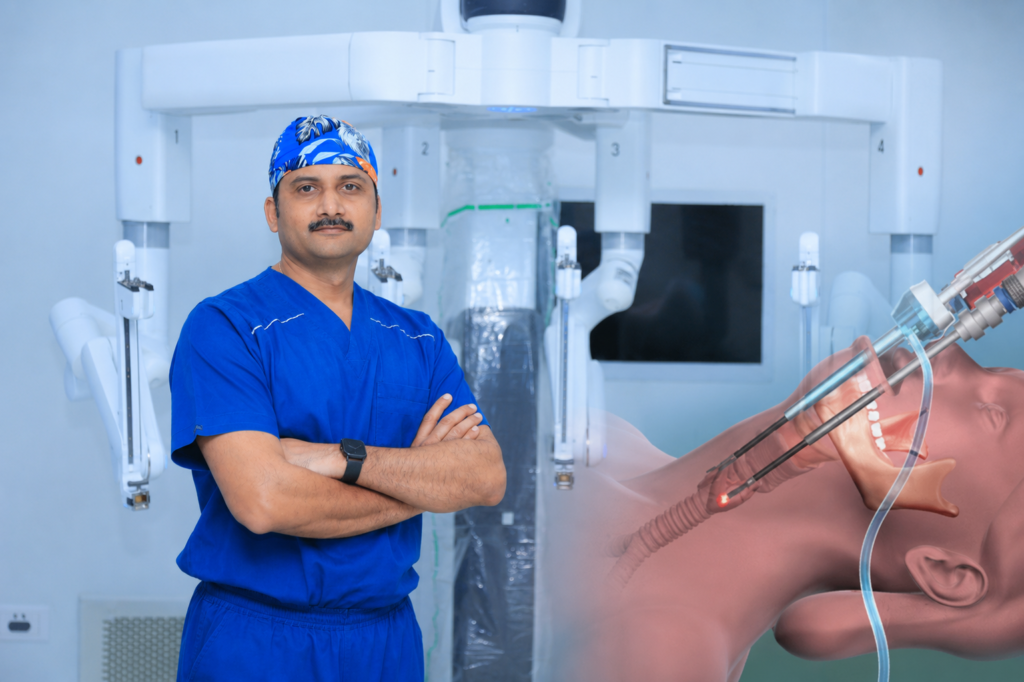
Scarless Thyroid Surgery
Advanced Trans Oral Endoscopic Thyroid Surgery (TOETVA)
Scarless | Less Pain | Safe | Faster Recovery
Experience the next generation of thyroid surgery—where the operation is performed through the mouth, leaving absolutely no visible scar on the neck while maintaining the same oncological principles and surgical safety as conventional thyroid surgery.
Why Scarless Thyroid Surgery?
Patients often believe and fear that thyroid surgery must leave a permanent neck scar. In today’s era, that is no longer true.
For carefully selected patients, Transoral Endoscopic Thyroidectomy Vestibular Approach (TOETVA) allows removal of the thyroid gland through small incisions hidden inside the lower lip. Since there are no cuts on the neck, there is no visible scar, allowing patients to recover with greater confidence while achieving excellent cosmetic outcomes.
The goal, however, is never cosmetic benefit alone. Every scarless thyroid surgery must remain a safe cancer operation first.
Why Patients Choose Scarless Thyroid Surgery
✓ No visible neck scar
✓ Less postoperative discomfort
✓ Faster recovery
✓ Early return to work
✓ Better cosmetic outcome
✓ High patient satisfaction
✓ Proven surgical safety in selected patients
Is Scarless Surgery Safe?
Scarless thyroid surgery is not an experimental procedure. It is an internationally accepted remote access technique for thyroid surgery performed in specialized centres around the world.
When performed in properly selected patients by an experienced thyroid surgeon, the risks to the recurrent laryngeal nerve, parathyroid glands, bleeding, and overall surgical outcomes are comparable to conventional thyroid surgery.
“Safety always comes before cosmetic benefit“
If scarless surgery is not the right option for you, we will recommend the approach that offers the safest treatment.
Who is Suitable?
Patients with
• Benign thyroid nodules
• Small thyroid cancers
• Selected multinodular goitre
• Graves’ disease (selected cases)
• Patients wishing to avoid a neck scar
Final suitability can only be determined after clinical examination, ultrasound and review of investigations.
Who May Not Be Suitable?
Scarless thyroid surgery is not suitable for everyone.
Patients with very large thyroid glands, advanced thyroid cancers invading surrounding structures, previous extensive neck surgery, or certain anatomical limitations may benefit more from conventional surgery.
The right procedure is the one that offers the safest and most effective treatment—not necessarily the scarless one.
Why Choose Dr. Siddharth Shah?
One of Western India’s Leading Surgeons in Scarless Thyroid Surgery
✓ Pioneer of TOETVA in Western India
✓ 100+ Scarless Thyroid Surgeries
✓ One of India’s Largest Personal Experience
✓ International Faculty & Live Surgical Demonstrator
✓ Invited Speaker at World Thyroid Conferences
✓ Advanced Head & Neck Oncosurgeon
Conventional vs Scarless Surgery
| Conventional | Scarless (TOETVA) |
|---|---|
| Neck incision | No visible neck scar |
| Excellent safety | Excellent safety in selected patients |
| Open surgery | Endoscopic surgery |
| Proven technique | Proven minimally invasive technique |
| Longer visible healing | Hidden incisions inside the mouth |
Both procedures are safe. The best operation is the one that is best suited to your disease—not simply the newest one.
Frequently Asked Questions
1. What is Scarless Thyroid Surgery?
Scarless Thyroid Surgery, also known as Transoral Endoscopic Thyroidectomy Vestibular Approach (TOETVA), is an advanced minimally invasive technique in which the thyroid gland is removed through small incisions hidden inside the lower lip. Since there is no incision on the neck, patients have no visible external scar while achieving the same surgical goals as conventional thyroid surgery.
2. Is scarless thyroid surgery as safe as conventional thyroid surgery?
Yes—when performed in appropriately selected patients by an experienced surgeon.
Multiple international studies have shown that TOETVA provides cancer control and surgical safety comparable to conventional thyroid surgery, with similar rates of complications involving the recurrent laryngeal nerve and parathyroid glands.
The key to safety lies in careful patient selection and surgical expertise.
3. Who is a suitable candidate for Scarless Thyroid Surgery?
Most suitable candidates include patients with:
- Benign thyroid nodules
- Selected thyroid cancers
- Follicular neoplasms
- Graves’ disease in selected cases
- Small to moderately enlarged thyroid glands
Not every patient is an ideal candidate. A detailed clinical evaluation, ultrasound examination, and, when required, biopsy are essential before deciding the most appropriate approach.
4. Will I have any scar on my neck?
No.
One of the biggest advantages of TOETVA is that all incisions are hidden inside the mouth, leaving no visible scar on the neck.
This makes it especially appealing for patients who wish to avoid a permanent neck scar for personal or professional reasons.
5. Is this surgery painful?
Most patients experience mild to moderate discomfort rather than severe pain.
Some patients notice temporary soreness inside the mouth or mild swelling around the chin during the first few days, which usually settles quickly with routine medication.
6. Is this surgery only for cosmetic reasons?
No.
Although the absence of a neck scar is a major benefit, TOETVA is far more than a cosmetic procedure.
It is an advanced minimally invasive operation that combines excellent cosmetic outcomes with safe thyroid surgery while maintaining the same oncological principles as conventional surgery.
7. Can thyroid cancer be treated using Scarless Thyroid Surgery?
Yes.
Selected patients with thyroid cancer can safely undergo scarless thyroid surgery. The decision depends on several factors, including:
- Tumour size
- Location
- Extent of disease
- Lymph node involvement
- Overall suitability
Your surgeon will determine whether this approach is appropriate after a thorough evaluation.
8. How long does the operation take?
The duration depends on the complexity of surgery.
In experienced hands, most procedures take approximately 2–3 hours, although more complex cases may require additional time.
9. How long will I stay in the hospital?
Most patients are discharged within 24 to 48 hours, depending on the extent of surgery and their recovery.
Many patients return to their normal routine within one to two weeks.
10. Will my voice be affected?
Protecting the voice is one of the most important goals of thyroid surgery.
The nerves controlling the vocal cords are carefully identified and preserved during surgery.
Temporary voice changes may occasionally occur, but permanent voice problems are uncommon, particularly when surgery is performed by an experienced thyroid surgeon.
11. What are the risks of Scarless Thyroid Surgery?
Like any thyroid operation, TOETVA carries certain risks, including:
- Bleeding
- Infection
- Temporary or permanent hoarseness
- Temporary or permanent low calcium levels
- Rare need to convert to an open procedure
These risks are carefully discussed before surgery and are minimized through meticulous surgical technique and appropriate patient selection.
12. Is robotic scarless thyroid surgery better than endoscopic surgery?
Both robotic and endoscopic transoral approaches aim to achieve the same goal—scarless thyroid surgery.
The choice depends on:
- Patient anatomy
- Disease characteristics
- Available technology
- Surgeon’s expertise
Each technique has specific advantages, and the most suitable approach is individualized for every patient.
13. Will I need lifelong thyroid medication?
Not always.
If only one lobe of the thyroid is removed, many patients continue to produce sufficient thyroid hormone naturally.
If the entire thyroid gland is removed, lifelong thyroid hormone replacement is necessary.
14. How experienced are you with Scarless Thyroid Surgery?
Dr. Siddharth Shah is among the pioneers of Scarless Thyroid Surgery (TOETVA) in Western India and has performed one of the region’s largest series of transoral thyroid procedures. He is regularly invited as faculty at national and international conferences and has trained surgeons in this advanced technique through live surgical demonstrations and academic workshops.
15. How do I know if I am eligible?
The best way to determine your suitability is through a specialist consultation. After reviewing your symptoms, ultrasound findings, biopsy reports, blood tests, and clinical examination, an individualized treatment plan can be recommended.
Common Myths About Scarless Thyroid Surgery
- Myth: Scarless surgery is only cosmetic.
Fact: It follows the same surgical principles as conventional thyroid surgery in carefully selected patients. - Myth: Cancer cannot be treated through a scarless approach.
Fact: Many patients with appropriately selected thyroid cancers are suitable candidates. - Myth: Scarless surgery is experimental.
Fact: TOETVA is an internationally established technique performed in specialized centres around the world. - Myth: Recovery takes longer than conventional surgery.
Fact: In fact, many patients recover faster and return to normal activities earlier.
Because Every Patient Deserves the Best Operation—Not Just the Smallest Scar.
The best thyroid surgery isn’t the one without a scar. It’s the one that offers the safest and most effective treatment for your disease.
When carefully selected and performed by an experienced surgeon, scarless thyroid surgery combines the proven principles of modern thyroid surgery with the unique benefit of leaving no visible neck scar. The right operation is always the one that is safest for you.
Real Patient Outcome
The photographs below show an actual patient before surgery and 3 months after Scarless Thyroid Surgery (TOETVA).
(Published with informed patient consent).
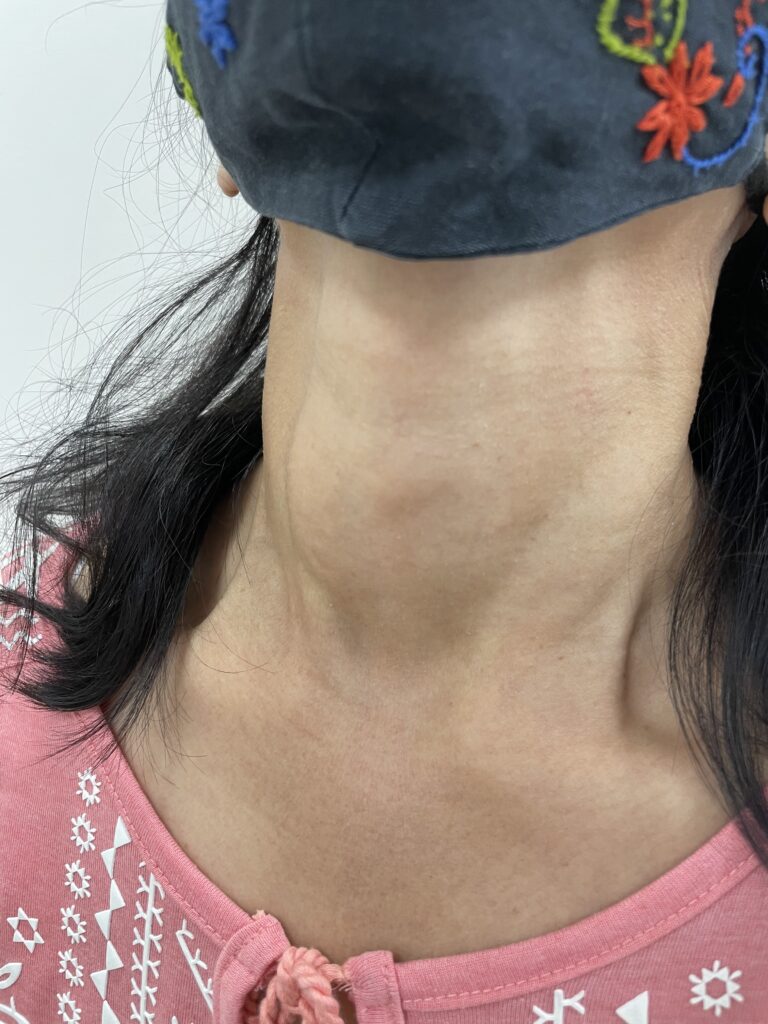
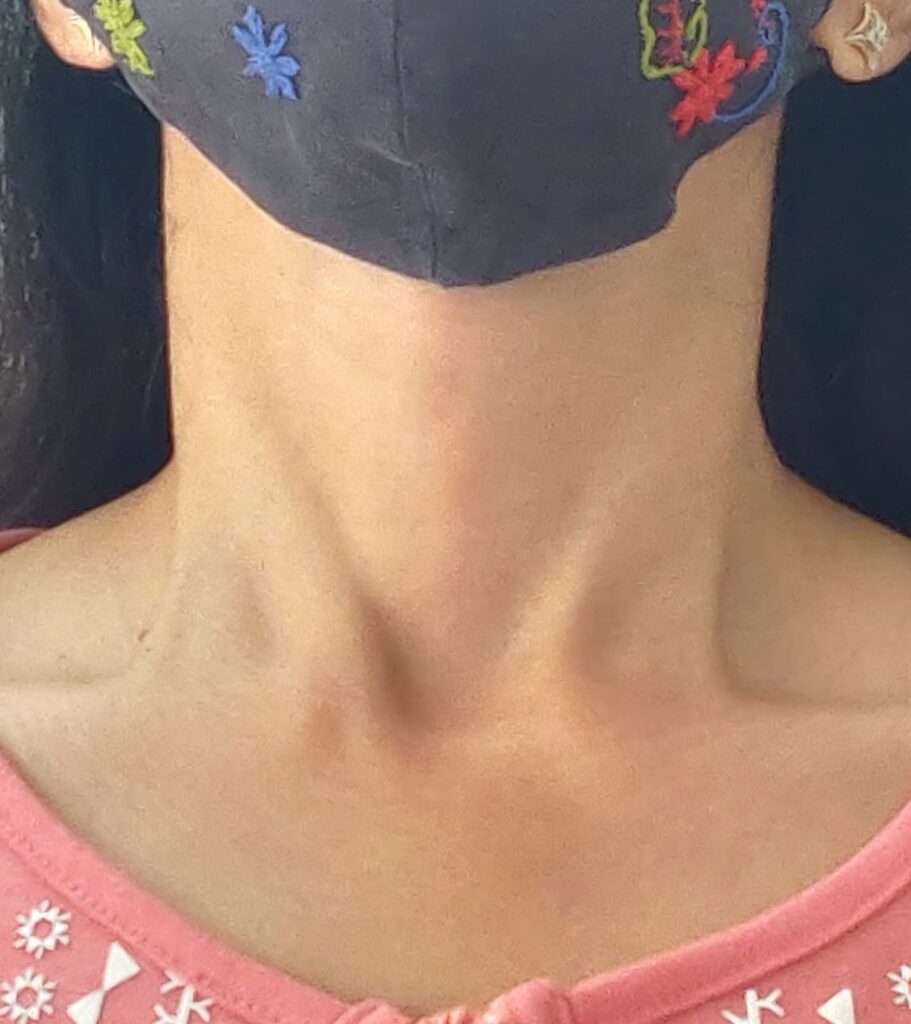
(Individual results vary depending on the underlying thyroid condition, patient anatomy, and healing characteristics.)
The only smile you should leave with is your own.